
Handbook of Corrosion Engineering
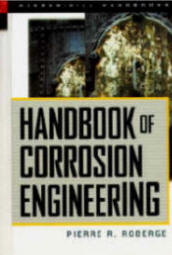
McGraw-Hill; Publication Date: 2000; ISBN 007-076516-2; 1140 pages ($115) by Pierre R. Roberge
This Handbook is aimed at the practicing engineer, as a comprehensive guide and reference source for solving material selection problems and resolving design issues where corrosion is possibly a factor. The book is divided in three main sections and is followed by supporting material in seven appendices. Each section and its chapters are relatively independent and can be consulted without having to go through previous chapters. The first section contains fundamental principles governing aqueous corrosion and high temperature corrosion and covers the main environments causing corrosion such as atmospheric, natural waters, seawater, soils, concrete, as well as microbial and biofouling environments.
The second section addresses techniques for the prediction and assessment of corrosion damage such as modeling, life prediction, computer applications, inspection and monitoring and testing through acceleration and amplification of corrosion damage. The second section also contains a detailed description of the various types of corrosion failures with examples and ways to prevent them. The third section covers general considerations of corrosion prevention and control with a focus on materials selection. This chapter is particularly valuable for its detailed descriptions of the performance and maintenance considerations for the main families of engineering alloys. This section also provides elements for understanding protective coatings, corrosion inhibitors, cathodic protection and anodic protection..
The appendices contain:
- A table of SI units making references to most other types of units.
- An extensive glossary of terms often used in corrosion engineering.
- A summary of corrosion economics with examples detailing calculations.
- A detailed introduction to basic electrochemical principles.
- Many examples of Pourbaix or E-pH diagrams
- Designations and compositions of engineering alloys.
- Download parts of the book (Knovel)
- Look inside the book and purchase (Amazon)
- Also available in Chinese
- Corrosion Engineering Companion
Connect with us
Contact us today