



|
|
|
|
Examine ways to recognize a corrosion problem
Describe the various forms of corrosion attack
Discuss the consequences of hidden corrosion
Compare the mechanisms that can initiate and propagate a corrosion process
This Module consists of twenty three Web pages of required reading. The pagination is visible at the bottom of each page with direct links to adjacent pages.
Additional information can be found in sections 6.1 to 6.5 of the reference textbook (Corrosion Engineering: Principles and Practice).
The previous Modules have introduced the general science of corrosion processes. In reality, the principles that govern these scientific concepts are rarely of interest to most people facing corrosion problems. The main questions these people generally ask are:
How serious is the problem?
How can it be fixed and how much will it cost?
What caused the problem in the first place?
The present Module will focus on answering the first of these questions and the next Module the last. Corrosion damage can take many shapes and forms that are often related to specific alloy/environment/operation conditions. The several forms of corrosion may be divided into three groups [1]:
Those recognizable with the unaided eye
Those which are more easily discerned with specific aids (e.g. dye penetrants, magnetic particles, or low-power microscopy)
Those which can only be identified definitely by optical or electronic microscopy
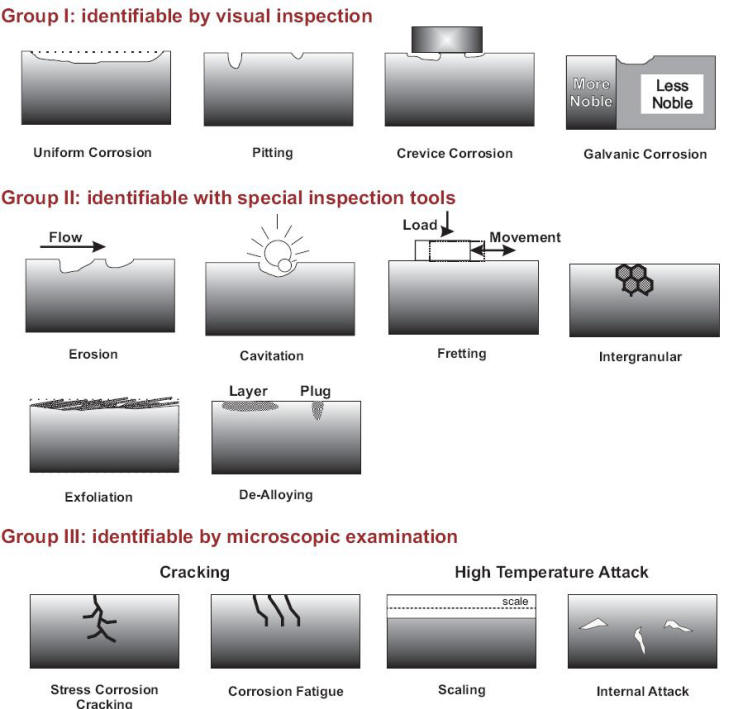
Main forms of corrosion attack regrouped by their ease of recognition
Much can be deduced from examination of materials which have failed in service. It is often possible by visual examination to decide which corrosion mechanisms have been at work and what corrective measures are required to solve the problem.
Corrosion problems can rarely be attributed to single forms of corrosion. Provide some examples to illustrate that statement.
| (previous) | Page 1 of 23 | (next) |
Velocity Induced Corrosion
See also CCE 513: Corrosion Engineering