
Jöns Jakob Berzelius (1779–1848)
Berzelius was born into a well-educated Swedish family, but he experienced a difficult childhood because first his father and then his mother died. While in medical school at the University of Uppsala, he read about Volta's "pile" and immediately constructed one for himself. His thesis for his medical degree was on the effect of electric shock on patients with various diseases. Even though he reported no improvement in his patients, his interest in electrochemical topics continued.
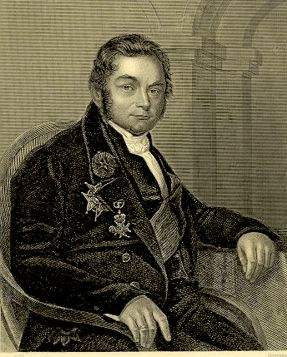
In 1807 Berzelius was made a professor at the Medical College in Stockholm, which soon after became the Karolinska Institutet, and a year later he began his long association with the Swedish Academy of Sciences. Jöns Jakob Berzelius was one of Humphry Davy's contemporaries and rivals. Like Davy he became an accomplished experimenter in the field of electrochemistry, but Berzelius mind was much more systematic than Davy's. He was given to running programs of hundreds of experiments and then deriving organized generalizations from them.
In preparing a chemistry textbook in Swedish for his medical students (Lärbok i Kemien vol. 1, 1808), Berzelius began the series of experiments for which he became most famous, those definitively establishing that the elements in inorganic substances are bound together in definite proportions by weight (the law of constant proportions). His interest in all sorts of compounds led to his discovery of a number of new elements, including cerium, selenium, and thorium. Students working in his laboratory also discovered lithium, vanadium, and several rare earths.
Using his experimental results, he determined the atomic weights of nearly all the elements then known. Dealing with so many elements in so many compounds motivated his creation of a simple and logical system of symbols (H, O, C, Ca, Cl, ...) which is basically the same as the system we use today, except that the combining proportions of the atoms of elements in a compound were indicated as superscripts instead of our subscripts. Berzelius also applied his organizing abilities to mineralogy, where he classified minerals by their chemical composition rather than by their crystalline type, as had previously been done.
The major intellectual synthesis of Berzelius career was "dualism", a line of thinking that could be traced back to the original electrochemical investigations both he and Davy had made. Because compounds were decomposed by an electrical current and released elements were formed at the poles in an electrolytic cell, he assumed that atoms were charged and chemical combination resulted from the mutual neutralization of opposite charges. Dualistic thinking worked quite well, except in the emerging realm of organic chemistry.
Berzelius was also a great organizer of men and institutions. As the Permanent Secretary of the Royal Academy of Sciences in Stockholm (1818–1848), he revived what had become a moribund organization. He continued to write textbooks, which were widely translated, and in 1822 he began a series of annual reports on the status of chemistry in Europe, which were also made available in other languages.
Connect with us
Contact us today