
Otto von Guericke (1602–1686)
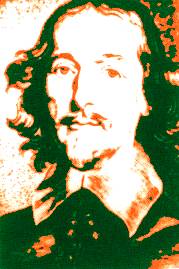 Otto Gericke was born as son of a patrician family resident for three centuries
in Magdeburg. Guericke family inherited extensive property both in the city
and in the countryside around it. At the age of 15, he entered the Faculty of
Arts at the Leipzig University. When Otto Gericke was 18 years old, his father
died and in 1621 he went to Jena to study at the university there. To complete
his studies, Otto Gericke studied in Leiden (Netherlands) in 1623. He especially
looked into problems of constructing fortresses for which mathematics, mechanics
and geometry were the most important subjects. After finishing his studies,
he went on a nine months journey through France and England as young men of
noble houses were entitled to.
Otto Gericke was born as son of a patrician family resident for three centuries
in Magdeburg. Guericke family inherited extensive property both in the city
and in the countryside around it. At the age of 15, he entered the Faculty of
Arts at the Leipzig University. When Otto Gericke was 18 years old, his father
died and in 1621 he went to Jena to study at the university there. To complete
his studies, Otto Gericke studied in Leiden (Netherlands) in 1623. He especially
looked into problems of constructing fortresses for which mathematics, mechanics
and geometry were the most important subjects. After finishing his studies,
he went on a nine months journey through France and England as young men of
noble houses were entitled to.
Guericke and corrosion monitoring
Otto von Guericke, demonstrated experimentally the capacity of the atmosphere to do work and decisively refuted the long-held notion that it was impossible for a vacuum to exist. Using hollow copper spheres and an air pump of his own construction, Guericke demonstrated that a partial vacuum could be created by pumping the air out of the sphere. He also proved that the air remaining in the sphere (at a pressure below that of the atmosphere) was distributed evenly throughout the vessel.
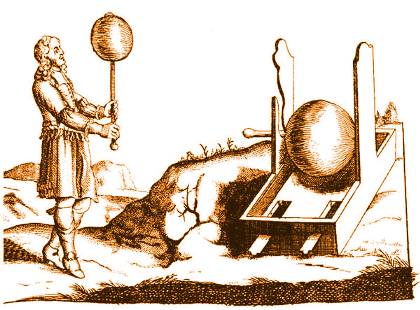
In 1663 Otto van Guericke invented the first electric generator, which produced static electricity by applying friction in the machine. The generator was made of a large sulfur ball cast inside a glass globe, mounted on a shaft. The ball was rotated by means of a crank and a static electric spark was produced when a pad was rubbed against the ball as it rotated. The globe could be removed and used as source for experiments with electricity. It is necessary here to note that von Guericke did not recognize the effect he generated as static electricity.
Later editions increased the speed of the rotation with a belt and and rotating wheel. Electrical demonstrations became a favorite parlor trick for guests, but the electric machine also allowed serious scientists to perform experiments that could not be performed earlier. It was Guericke who noted that like charges repelled each other.
In 1657, Guericke carried out his famous demonstration that several teams of horses could not pull apart two joined hemispheres when the air within had been evacuated. Using a piston in a cylinder, he also showed that when a vacuum was created on one side of the piston, the atmosphere would move the piston and a considerable mass through a distance, thus performing work. This became the basic principle of the Newcomen steam engine (1712).
Connect with us
Contact us today