Ulick Richardson Evans (1889-1980)
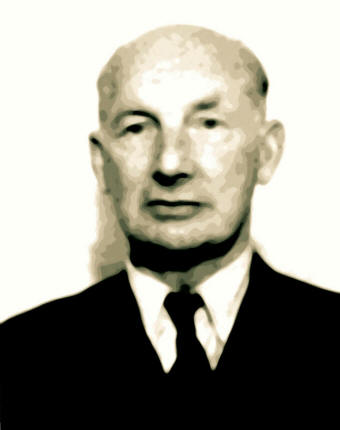 Evans was born in Wimbledon and educated at Marlborough College, 1902-1907,
and King's College, Cambridge, 1907-1911, where he read for
the Natural Sciences Tripos, specializing in chemistry for Part II. He then
began research on electrochemistry at Wiesbaden and London which was cut short
by the First World War. He served in the army from August
1914 until 1919.
Evans was born in Wimbledon and educated at Marlborough College, 1902-1907,
and King's College, Cambridge, 1907-1911, where he read for
the Natural Sciences Tripos, specializing in chemistry for Part II. He then
began research on electrochemistry at Wiesbaden and London which was cut short
by the First World War. He served in the army from August
1914 until 1919.
At the end of the war he returned to Cambridge where he spent the rest of his life, researching and writing prolifically on corrosion and oxidation of metals.Ulick Richardson Evans was described in the Biographical Memoirs of Fellows of the Royal Society as the "Father of the modern science of corrosion and protection of metals". His major contribution to the subject involved placing on a firm foundation the electrochemical nature of corrosion.
His first paper in this area was published in 1923, which was followed in 1924 by his book "Corrosion of Metals", the first text book devoted to the subject. He continued to publish research papers for the next 50 years, as well as updating his classic text.
UR Evans & Marcel Pourbaix
Historical Theories on Corrosion
Probabilistic Corrosion
Palladium Medal Award to U.R. Evans
Journal of the Electrochemical Society, 102, 8, 193C, 1955
Ulick Richardson Evans of Cambridge, England,
has been selected by The Electrochemical Society as 1955
Palladium Medalist. Dr. Evans will receive the third impression of the medal
at the banquet on October 11, held in connection with the Fall Meeting of the
Society at Pittsburgh,
Dr. Evans is a distinguished scientist, who has written five books and about two hundred papers on electrochemistry and corrosion. He has probably done more than any other individual to place die corrosion of metals on a quantitative, scientific basis. On the fundamentals elucidated by Dr. Evans is based most of the engineering progress that has advanced the prevention of corrosion to such a high stage of development during recent years.
His first book, "Metals and Metallic Compounds," was published in four volumes in 1923. During the writing of this book he became impressed by the lack of scientific knowledge of corrosion processes. Thus he started the work on this subject for which he became famous. In 1924 his book on "The Corrosion of Metals" was published. This was subsequently translated into German, French, and Russian, and was followed by a second edition in 1926. In 1937 his book "Metallic Corrosion Passivity and Protection" was issued. This was probably the most comprehensive book ever written by one man on corrosion and protection.
His latest book, "An Introduction to Metallic Corrosion," was published in 1948.
The top floor of the old Chemical Laboratory Building, Pembroke Street, in Cambridge was the scene of most of Evans' experimental work. He excelled in designing and carrying out critical experiments with a minimum of complicated equipment. His interest in the theory of probability and applications of statistics began at an early age, and he was quick to apply these valuable tools to the study of corrosion.
His fame in his chosen field attracted numerous research students to him. Men from many foreign countries, as well as from the British Isles, worked in his laboratories under his guidance. It was a stimulating and valuable experience for all of them. Honors also came to him as a result of his work. He was awarded a D.Sc. degree from Cambridge University in 1932 and from Dublin University in 1947. He received the Armourers' and Brasiers' Research Fellowship from the Royal Society in 1933, and the Willis Rodney Whitney Award of the National Association of Corrosion Engineers in 1948. He was elected Fellow of the Royal Society in 1950.
Dr. Evans retired from his formal connection with Cambridge University in the fall of 1954 but he remains active in carrying out research in corrosion and as chairman and member of various committees in this field. The first Palladium Medal Award was conferred on Dr. Carl Wagner in 1951, then Visiting Professor of Metallurgy at Massachusetts Institute of Technology, during the Fall Meeting of the Society in Detroit.
The second Palladium Medal was awarded to Dr. Nathaniel Howell Furman, of Princeton University, in 1953 during the Society's Fall Meeting in Wrightsville Beach, N. C. The metal used for the medal, and its design, have an interesting significance in connection with the award. The use of palladium explains the selection of the figure of the Greek goddess,Pallas Athena, which appears on the back of the medal, and after whom palladium, a member of the platinum group of metals, was named. Alchemical symbols of other metals surround the figure of the goddess, who, according to mythology, protects materials against destruction by the elements. Thus, the metals are secure against the corrosive influence of their environments.
Excerpt from An Introduction to Metallic Corrosion, Edward Arnold, London, UK, 1948.
"The chronological sequence of scientific discovery is rarely the logical one. To arrange the facts of metallic corrosion historically would conceal the true interconnection existing between them, and thus deprive them of significance. Nevertheless, in view of the prevailing interest in the History of Science, many readers may welcome a short narrative showing how knowledge of the subject discussed in this book has grown. The note which follows should serve to indicate some names and dates associated with the advance of understanding, but it must be remembered that the credit for any particular discovery cannot be assigned to a single year or to a particular person. If a recent investigator is cited as the discoverer, objection may fairly be raised by the quotation from older papers of passages which seem to contain the germ of the idea; yet to allot the entire credit to early investigators may be unjust to later ones, who have established as facts what had previously been mere suggestions."
"At the Dawn of History, the first metals to be used were those which were either found native, or could easily be reduced to the elementary state ; such metals do not readily pass into the combined state, and their corrosion can have raised no serious problem s. But with the introduction of iron, the problem of its corrosion must have presented itself, although it is an undoubted fact that some of the iron produced in Antiquity is to-day more free from corrosion than much of that manufactured in later years. This may have been due partly to the fact that iron reduced with charcoal contained less sulphur than modern steel, but it may also be connected with the absence of sulphur compounds from the air in the days before coal was adopted as a fuel ; for it is often the conditions of early exposure which determine the life of metal-work. Whatever the cause, ancient iron has in some cases remained in surprisingly good condition for many centuries ; the Delhi Pillar is the example which has excited most interest, but others could be quoted."
"For many centuries there seems to have been little curiosity regarding the causes of corrosion, although a few significant observations were made. As early as 1788, Austin noticed that water, originally neutral, tends to become alkaline when it acts on iron. He attributed the alkalinity to the compound now called ammonia ; this was probably an error, since the alkaline reaction produced by most saline waters is due to sodium hydroxide, the cathodic product of the electrochemical corrosion process."
Connect with us
Contact us today