
Pieter (Petrus) van Musschenbroek (1692-1761)
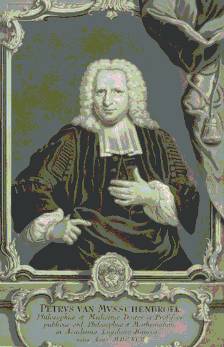 Musschenbroek was born on 14 March 1692 in Leiden, Netherlands, into a family
of instrument makers. At the time of Petrus' (Pieter's) birth the family
was turning to the making of scientific instruments (air pumps, microscopes,
and telescopes) which may explain in part his interest in science. He studied
at the University of Leyden (Leiden) and received his degree in medicine in
1715 and later his doctor of philosophy degree in natural philosophy (physics).
He then visited England in 1717 and met Isaac Newton.
Musschenbroek was born on 14 March 1692 in Leiden, Netherlands, into a family
of instrument makers. At the time of Petrus' (Pieter's) birth the family
was turning to the making of scientific instruments (air pumps, microscopes,
and telescopes) which may explain in part his interest in science. He studied
at the University of Leyden (Leiden) and received his degree in medicine in
1715 and later his doctor of philosophy degree in natural philosophy (physics).
He then visited England in 1717 and met Isaac Newton.
Upon returning to the Netherlands, he became a professor of natural philosophy and mathematics at the University of Duesberg (Duisburg) in 1719. He also introduced Newton's ideas to the Netherlands. He held professorships (from 1721) at the Universities of Duesberg, Utrecht, and Leyden (Leyden from 1740 to 1761). He left the University of Utrecht for the University of Leyden and taught natural philosophy (physics). He provided the first approach to scientific study of electrical charge and its properties. In 1729, he used the word "physics" which had never been used before.
In their attempts of November 1745 to produce sparks and flashes by friction that Gilbert, von Guericke, Hauksbee, and Dufay had previously done experimentally, professors Petrus (Pieter) Musschenbroek and Jean Allamand of the University of Leyden and friend Cunaeus experimented with a glass jar connected to an friction electrical machine.
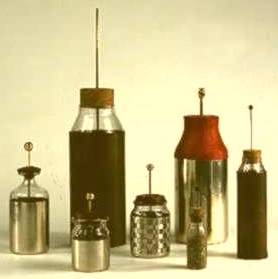
Musschenbroek had suspected that a nonconductor vessel (glass) would be helpful to them so on this occasion in January 1746 he partly filled a bottle with water. He knew that water was a conductor of electricity. Musschenbroek, while holding the jar with his right hand and a piece of wire with his left hand had one of his assistants connect it to the friction electrical machine, and then turn its glass globe, but nothing occurred until Cuneus placed one end of the wire into the water while Musschenbroek, grounded, was still holding the wire. A violent shock was felt which Musschenbroek described. The jar device had accumulated the electricity produced by the static machine and then all at once it discharged to Musschenbroek.
Musschenbroek was elected a Fellow of the Royal Society of London in 1734, and member of the French Academy of Sciences in the same year. Musschenbroek authored:
- Physicae experimentales et geometricae dissertationes in 1729
- Elementa physicae in 1734
- Introductio ad philosophiam naturalem in 1762
The credit for creation of the Leyden jar has varied. Some writers give credit to Ewald Jurgen von Kleist, a German, while others claim that van Musschenbroek, a Dutch physicist, was the real inventor. A few authors give credit to both personalities as well as to others. If dates could settle this issue (4 Nov 1745 vs. Jan 1746, respectively) then von Kleist would be the inventor, and van Musschenbroek would be the first to develop a working model of the first electrical storage devise.
These men, working independently, discovered that electricity produced by an electrostatic machine could be accumulated. Both men were horrified and surprised when their newly created device discharged stunning them with a strong electrical shock.
Connect with us
Contact us today