Michael Faraday (1791-1867)
Michael Faraday, the discoverer of electro-magnetic induction, electro-magnetic
rotations, the magneto-optical effect, diamagnetism, field theory and much else
besides, was born in Newington Butts (the area of London now known as the Elephant
and Castle) on 22 September 1791. In 1805at the age of fourteen Faraday was
apprenticed as a bookbinder to George Riebau of Blandford Street. During his
seven year apprenticeship Faraday developed his interest in science and in particular
chemistry. He was there able to perform chemical experiments and built his own
electro-static machine. (reference)
But, more importantly, Faraday joined the City Philosophical Society in 1810. In this society, which was devoted to self-improvement, a group of young men met every week to hear lectures on scientific topics and to discuss scientific matters. This is where Faraday would give his first scientific lectures.
Towards the end of his apprenticeship, in 1812, Faraday was given, by one of Riebau's customers, William Dance, four tickets to hear Humphry Davy's last four lectures at the Royal Institution. Faraday attended these lectures took notes and later in the year presented them to Davy asking for a position in science. Davy interviewed Faraday, but said that he had no position available. Early in 1813 there was a fight in the main lecture theatre of the Royal Institution between the Instrument Maker and the Chemical Assistant which resulted in the dismissal of the latter. Davy was asked to find a replacement for him and he remembered Faraday. Davy called Faraday for a second interview the result of which was that Faraday was appointed Chemical Assistant at the Royal Institution on 1 March 1813. Faraday, in effect, started a second apprenticeship in chemistry.
Faraday and corrosion monitoring
Faraday's Law
For most of the 1810s and 1820s he worked under Davy's replacement as Professor of Chemistry, William Thomas Brande. However, between October 1813 and April 1815, he accompanied Davy, as his assistant, on a scientific tour of the Continent. Davy had been given a passport by Napoleon for himself, his wife, her maid and a valet. Faraday, very reluctantly, agreed to also perform this latter role. On the tour they visited Paris, Italy where they met the aged Volta, visited Vesuvius and Davy was able to decompose a diamond into carbon by using the Duke of Tuscany's great lens, Switzerland and Southern Germany.
Back in England, Faraday resumed his position as Chemical Assistant at the Royal Institution and continued to learn his science from Brande as well as occasionally helping Davy as with the Miner's Safety Lamp in 1816 and 1817. Between 1818 and 1822 he worked with the surgical instrument maker James Stoddart in improving the quality of steel. The year 1821 was in many ways one of the most important in Faraday's life. On 21 May 1821 he was promoted in the Royal Institution to be Superintendent of the House. On 2 June he married Sarah Barnard who was a member of one of the leading Sandemanian families in London.
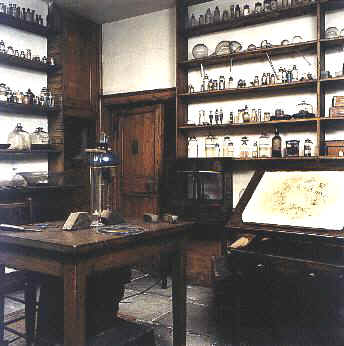
The year was also the one when he made his first major contribution to natural knowledge. In 1820 the Danish natural philosopher Hans Christian Oersted had discovered electro-magnetism. This he announced in a paper written in Latin, but was quickly translated into the major scientific languages of Europe.It was immediately evident that Oersted had made a major discovery. What was clear was that Oersted had opened up a major field of scientific enquiry which was exploited by savants all over Europe. Faraday was part of this effort and on 3 and 4 September 1821 in his basement laboratory at the Royal Institution, he undertook a set of experiments which culminated in his discovery of electro-magnetic rotation - the principle behind the electric motor.
In the ensuing decade following this discovery, Faraday's opportunity for doing original research was severely circumscribed by his lecturing activiites, although he was able to liquefy chlorine in 1823 and discover bicarbuet of hydrogen, later renamed benzene by Eilhard Mitscherlich, in 1825. It was not until nearly ten years to the day after his discovery of electro-magnetic rotations that Faraday was able to resume his work on electro-magnetism, when he discovered on 29 August 1831, electro-magnetic induction. This is the principle behind the electric transformer and generator. It was this discovery, more than any other, that allowed electricity to be turned, during the nineteenth century, from a scientific curiosity into a powerful technology.
During the remainder of the 1830s Faraday worked on developing his ideas on electricity. He enunciated a new theory of electro-chemical action between 1832 and 1834 one of the results of which was that he coined many of the words now so familiar - electrode, electrolyte, anode, cathode and ion to name but five. In the later half of the 1830s Faraday worked on a new theory of static electricity and electrical induction. This work led him to reject the traditional theory that electricity was an imponderable fluid or fluids. Instead he proposed that electricity was a form of force that passed from particle to particle of matter.
Between 1830 and 1851 Faraday was Professor of Chemistry at the Royal Military Academy in Woolwich. During his tenure generations of officers of the Royal Engineers and Royal Artillery learnt their chemistry from him. He died at Hampton Court on 25 August 1867 and was buried in the Sandemanian plot in Highgate Cemetery five days later.
Connect with us
Contact us today